How I evaluate Commodity Mining Stocks
and the 1 mistake to avoid at all costs

This one’s on Commodity Mining Stocks and let’s first talk about the mistake to avoid
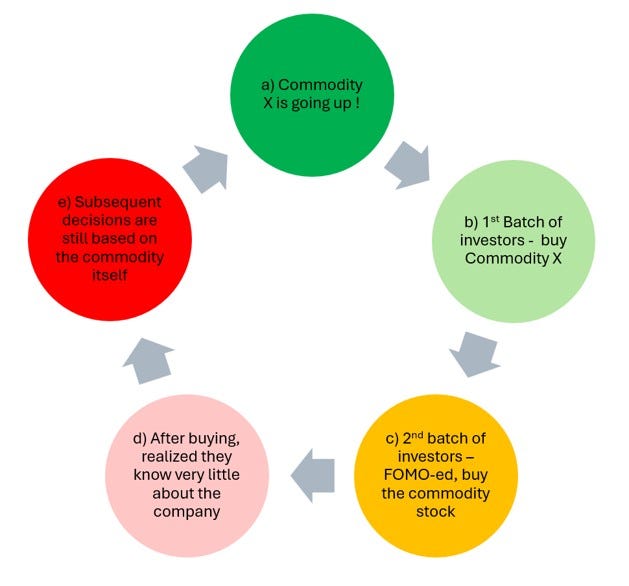
The cycle of regret - Don’t be the 2nd batch of investors (in orange)
a) Something goes up
b) 1st batch of investors sees something going up and buys in leading to further uptrends
c) 2nd batch of investors have FOMO-ed and missed the boat.
They have no clue where its going next and are unwilling to buy the actual commodity ‘since it’s already gone up so much’
so they look for a stock which is mining the commodity,
ideally the one that’s ‘gone up the least’
d) After buying, they realize they have very little knowledge about the company (is it profitable? what are their margins? where are they based? What’s the PE, PB, Div yield? etc)
e) Subsequent decisions on whether to add more or sell is based on the commodity itself, so they’re back where they started – guessing the commodity price, something they have very little expertise in
And this phenomenon has repeated for decades and decades, across oil, copper, gold, etc to the point where we are commodity agnostic. If anything, history has taught us to not be the 2nd group of investors.
The reality is most of us have minimal edge in predicting commodity price on a consistent basis, but we don’t need to guess to benefit from this.
Stop guessing the commodity price – invest in producing assets
Here’s the Valuation Based Investing (VBI) reframe - a mining company isn’t a bet on a commodity price. It’s a business — and like any business, what matters is whether it can make money.
A good miner is profitable across a wide range of commodity prices, not just at today's price. No business is profitable at any price — an oil company won't make money if oil goes to zero — but a good one should stay above water across a wide range of realistic prices. Take an oil producer with a cost of production of $30 a barrel. At $40 oil, they make X. At $50, they make 2X. At $60, 3X, and so on. The commodity price moving is upside or downside to an already-profitable business — not the entire investment thesis.
Or to put more brutally – it’s the choice between
· Stock X is profitable as long as oil price stays above $30 is an entirely different proposition to
· After I buy oil, it must go UP for me to be profitable
In both cases, just like the ‘2nd batch of investors’, I still have no clue on where the oil price is going, but its much easier to be profitable in the first case.
Compare it to estate agents. The best ones close deals whether the property market is roaring or stuck in the mud — they’ve got the skill and the client base to make it work either way. How highly would you rate an agent who only sells when the market is strong? Or for that matter the property investor who’s only profitable when mortgage rates are 1%?
Same thing.
So how can we invest in commodity mining stocks using the lens of producing assets, VBI style?
We’ve talked about the cycle of regret as commodity‑agnostic: it doesn’t care whether you chased oil, gold, copper or even bitcoin, the pattern is the same. The way you look at miners should be just as commodity‑agnostic. At a high level, every miner has to do three things:
find the stuff (in the ground?),
dig up the stuff, and
sell the stuff.
The lens that follows works across that whole spectrum – whether the company is drilling for oil, hauling copper or processing gold, the core questions you ask about the business remain the same. Therefore, the very first starting point MUST BE to ask whether the stuff coming out of the ground is something the world genuinely needs and is useful to society over time.
Take oil as an example. We obviously can’t control the price of oil — that’s the guessing game we’re trying to avoid to begin with. But it doesn’t take much to check global consumption followed a steady, long‑run upward trend for decades. Oil is required and existential for energy (water, heating, cooking, etc). Notice the distinction: you’re indifferent to which commodity a miner produces, because you’re not trying to guess where its price goes next. But you’re not indifferent to whether the world will keep needing that commodity in the first place.
We don’t know tomorrow’s price, you leave alone but we can certainly check yesterday’s demand.
During COVID, when the entire global economy shut its doors, oil consumption dropped by roughly 10%. Ten percent. If you were running a local café, a high street barber, a restaurant — anything consumer-facing — you’d have taken a far bigger hit than that. Oil demand dipped and recovered. VBI lens says: start there. Make sure the thing being dug up is genuinely useful and beneficial to society, so you’re anchored in durable demand rather than a passing fad.
Once you’ve passed that “useful stuff” test, you can move to three practical checkpoints that focus on the miner as a business rather than a proxy for the commodity price:
Production: is output growing or at least stable? A good company should get better at what they do over time - better at finding, extracting and processing, selling. The whole value chain. And when production drops dramatically, it should hopefully be by management choice and not by circumstance.
If you were asked to invest in your friend’s café, wouldn’t you WANT to see them get more efficient at brewing more coffees, baking more cakes, etc? Sure, market forces mean they can’t set coffee price at whatever they want but still, they should WANT to be more efficient over time. So this is straight up a test of management’s competency and operational excellence
Commodity‑price hedge / market‑risk policy: You don’t like to guess commodity price, guess what, some miners don’t like it either. So the question is how does the company handle big swings in the underlying price? Do they hedge a portion of production, set clear limits on trading, or deliberately run unhedged? The policy is usually spelled out for you; you can decide if it matches the level of risk you’re comfortable owning.
Depreciation: heavy machinery, infrastructure and finite resource life mean these businesses are capital‑intensive. Don’t stop at headline EBITDA; look at how much value they’re burning through in equipment and assets each year, and whether cash generation is strong enough to sustain and renew those assets without constantly stretching the balance sheet.
Framed this way, you’re not trying to be smarter than the market on where oil or copper will trade next month. You’re checking whether the miner is tied to something the world reliably needs, and whether it runs a robust, well‑managed operation around that reality.
Part 1 conclusion
If you take away one thing from this piece, let it be this: don’t be investor number 2 from the cycle of regret. Don’t be the one who watches the commodity run, panics, and buys the miner without knowing much about that specific business. That’s not a strategy – it’s basically a FOMO-glorified hunch dressed up as investing. It’s by far and away the most common and regrettable mistake. Avoid it.
Instead, miners (of any commodity) should be assessed with the VBI lens – are they actual producing assets? Is what they dig up, genuinely useful for society?
This article forms the opening gambit. If you find this lens useful, I’ll put it work for a next article, with a more comprehensive checklist on actual examples – one each for oil, metals, and gold (I promised to be commodity agnostic).
Same questions. Real companies. Let’s see what they tell us.
Regulatory Notice
This publication shares educational insights and personal investing frameworks only. It is not financial advice, investment recommendations, or guidance to buy/sell any asset.
I am not authorised or regulated by the FCA (UK) to provide advice.
Past performance is no guide to future results. All investing carries risk of capital loss. Always, always do your own research or consult qualified professionals suited to your circumstances.